

Walnut Bedside Table:
How to Choose a Piece That Feels
Premium, Practical, and Timeless
Walnut is one of the most beautiful woods available for bedroom furniture — but choosing it wrongly is an expensive mistake. The wrong finish strips away its warmth. The wrong structure undermines its longevity. And the wrong sourcing means paying premium for something that isn’t what it claims to be.
A good walnut bedside table earns its price through three things: genuine material (solid walnut or quality veneer with a real walnut face — not foil), finish quality (a natural oil or hardwax that lets the wood breathe, not a thick lacquer that traps it), and honest grain matching (panels selected so the surface looks composed, not random). Get all three right and walnut is furniture that genuinely improves with age.
- Solid walnut: richest colour, most tactile, fully repairable — costs more, worth it for 15+ year ownership
- Quality walnut veneer on solid substrate: legitimate alternative — specify 1.5mm+ veneer with solid wood edge lipping
- Always verify: oil or lacquer finish, moisture content (8–12%), FSC or EUDR documentation for EU purchases
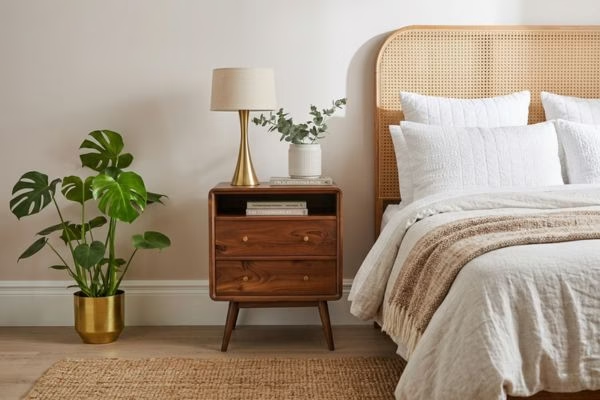
There’s a specific quality to a well-made walnut bedside table that’s difficult to articulate and very easy to feel the moment you’re in the room with one. The colour is warm but not loud. The surface feels different from everything else in the room — denser, more honest. And over the years it seems to get more settled, more itself, rather than more worn.
That quality isn’t automatic. It comes from a combination of decisions — about the material, the finish, the proportions, and the joinery — that the label “walnut bedside table” tells you nothing about. A €95 piece and a €750 piece can both carry that label. What makes the difference is what this guide covers.
The conversation isn’t about convincing you to spend more. It’s about helping you understand what you’re actually evaluating — so that whatever you spend, you’re spending it with full knowledge of what you’re getting.
1. The Biggest Question First: Solid Walnut or Walnut Veneer?
This is the question most product listings are deliberately vague about — which is itself a signal. Confident suppliers are clear about what they’re selling. Let’s be clear here.
What a Solid Walnut Bedside Table Truly Offers
Solid American black walnut (Juglans nigra) or European walnut (Juglans regia) is heavy, dense, and unapologetically itself. Running your hand along the grain, you feel the micro-relief of the annual rings — lighter summerwood, denser springwood, alternating in a rhythm that no synthetic surface can fully replicate. It is a genuinely tactile material, and that tactility is part of what you’re paying for.
Structurally, solid walnut holds joints extremely well and responds to repair — a surface scratch can be addressed with fine steel wool and oil; a deeper mark can be sanded back. The material can be refinished multiple times over decades without losing structural integrity. A well-made solid walnut bedside table is realistically a 25–30 year piece, possibly longer.
When Walnut Veneer Is Actually a Smart Choice
Quality walnut veneer — and this distinction matters enormously — is a slice of real walnut wood (1.5–3mm thick) bonded to a dimensionally stable substrate, typically furniture-grade HDF or birch-core plywood. This is not the same as printed foil that photographs like walnut. It is real walnut, with real grain pattern and real tactile texture, applied in a way that offers certain structural advantages over solid wood in wide-panel applications.
Wide solid walnut panels — tabletops larger than 30–35cm — are susceptible to movement across the grain with seasonal humidity changes. A properly engineered veneered panel is more dimensionally stable precisely because the substrate is engineered for stability. High-end furniture has used this approach for centuries; it’s an engineering choice, not a compromise.
The key specifications that make veneer worth choosing: veneer thickness of at least 1.5mm (thin foil at 0.3–0.6mm is a different product entirely), solid walnut edge lipping on all visible edges (so the piece reads as solid from every angle), and a furniture-grade substrate rather than standard particleboard. Whether working with solid or premium veneer, structural integrity that meets export standards is the baseline — not a differentiator.
How to Decide Based on Your Long-Term Bedroom Goals
| Your situation | Solid walnut | Quality veneer |
|---|---|---|
| Long-term home, 15+ years in same bedroom | ✓ Best choice | △ Acceptable if quality spec |
| Rental or medium-term (5–10 years) | △ May be over-investment | ✓ Better value proposition |
| Wide panel design (tabletop > 40cm) | △ Needs careful joinery design | ✓ More dimensionally stable |
| Tactile, authentic material experience | ✓ Unmatched | Good if veneer is 1.5mm+ |
2. What You’re Really Paying For: Craftsmanship & Consistency
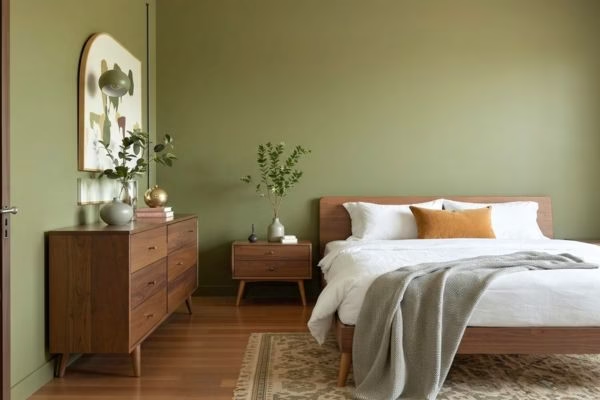
Walnut is not a forgiving wood when worked carelessly. Its striking grain pattern — the signature feature that makes it so desirable — is also what makes poor craftsmanship so immediately visible. Two pieces of walnut bedside table at similar price points can look completely different purely because of how the timber was selected and assembled.
Grain Matching: Why Good Walnut Looks “Calm” and Poor Matching Looks Cheap
Walnut grain is highly variable — you can get straight, flowing lines; dramatic swirling figure; contrasting pale sapwood against rich chocolate heartwood; and everything in between. The skill of a good maker lies not in avoiding this variation but in selecting and arranging it so the finished piece reads as visually coherent. Adjacent panels with matched grain direction feel composed. Panels assembled without attention to grain direction look restless and random — which is exactly the opposite of what you want from walnut.
The presence of sapwood — the pale, near-white outer ring of the tree — is a particular point of distinction in approach. Some manufacturers avoid sapwood entirely, creating a uniformly rich, dark surface. Others use sapwood deliberately as a design element, treating the contrast as part of the material’s honesty. Both approaches can be beautiful. What you want to avoid is sapwood appearing randomly and unintentionally — which reads as a wood selection that wasn’t thought through.
- Do adjacent panels flow in the same grain direction? (Desired: yes)
- Is sapwood present, and if so does it appear intentional or accidental? (Intentional: fine; random: avoid)
- Is the surface colour consistent from edge to edge, or are there visible patchwork transitions suggesting rushed timber selection?
- On the drawer front: does the grain of the front visually continue from the carcass beside it, or is it clearly a different board?
The Tactile Experience: Joinery, Edge Detailing, and Drawer Feel
In solid walnut bedside tables, quality joinery is not visible by definition — it’s hidden within the structure. What you can assess is the evidence of it: the rigidity of the structure under a gentle diagonal push (quality joinery produces near-zero flex), the precision of corner transitions (hairline gaps indicate movement under load), and the smoothness of drawer operation (which depends on both runner quality and the dimensional accuracy of the drawer box itself).
Edge detailing on a quality walnut piece — a small chamfer or radius on the tabletop edge, a subtle reveal between drawer front and carcass — requires machine time and human attention that budget production skips. These details don’t serve a purely structural function. They serve a sensory one: they’re what your hand feels when you run it along the piece at night without looking, and they’re what communicates “this was made carefully” before your brain has consciously registered anything.
⇒ Read more: How to Choose the Right Bedside Table: Size, Style, and Practical Tips
3. Finish Changes Everything: The Same Walnut Can Look Completely Different

This is the factor that most buyers overlook entirely — and it’s the one that determines more than any other how the piece feels to live with every day and how it ages over years.
Oiled vs Lacquered: Comparing Warmth, Touch, and Maintenance
Take the same piece of solid walnut, finish one side with a natural hardwax oil and the other with a high-gloss polyurethane lacquer. Hold them under the same light. They don’t look like the same material.
- Penetrates the wood — no surface film
- Walnut reads as warm, almost velvety
- Grain is tactile under your fingertip
- Colour deepens and enriches with re-oiling
- Scratches blend rather than shatter
- Spot-repairable without full refinishing
- Low-VOC when water-based — bedroom-safe
- Re-oil every 12–18 months on surfaces in use
- Creates a hard film over the wood surface
- Walnut reads as cooler, more formal
- Grain visible but not tactilely accessible
- Colour is fixed at point of application
- Scratches break the film — visible as bright lines
- Full strip and refinish required for repair
- Solvent-based types off-gas; water-based better
- No maintenance but harder to correct damage
The choice between them is partly aesthetic preference and partly a practical one about how much maintenance you’re willing to engage in. Oil-finished walnut asks something of you — an occasional afternoon with a cloth and a tin of oil — and gives back something: a surface that responds to care visually, deepening in richness rather than simply persisting.
Why Low-VOC Natural Finishes Are Crucial for Bedroom Air Quality
A bedroom is where you spend 7–9 hours every night in close proximity to everything in it. The off-gassing profile of furniture finishes matters in this context more than in almost any other room in the home. Solvent-based lacquers and conventional PU coatings can off-gas VOCs for weeks or months after application — detectable as that “new furniture” smell that some people find pleasant and some find irritating.
Water-based hardwax oils and water-based lacquers are significantly lower in VOC content and cure more completely. Low-VOC, water-based European oils — specifically formulated for bedroom furniture — allow the wood to breathe and maintain its natural warmth while posing no meaningful air quality concern once cured. For families with children or anyone with respiratory sensitivity, this specification should be a non-negotiable requirement, not an optional upgrade. The best manufacturers apply this finish type as standard; it’s worth confirming before purchase.
4. Do Walnut Bedside Tables Get Better with Age?

This is one of the most genuinely interesting questions about walnut as a material — and the answer is more nuanced than the simple “walnut ages beautifully” line you’ll find in most marketing copy.
The Mellowing Effect: How Walnut Subtly Shifts Colour Over Time
Freshly cut and finished walnut is deeply dramatic — rich chocolate browns, sometimes almost purple-tinged, with pale sapwood contrasting sharply. Over the first 2–5 years of exposure to ambient light, walnut mellows. The dark areas become slightly lighter and warmer, moving toward a more uniform honey-caramel tone. The contrast between dark heartwood and pale sapwood softens.
Many people find that walnut furniture at 10 years looks more refined than at 1 year — the mellowed, unified tone feels more composed and settled than the high-contrast freshness of new walnut. This is not deterioration; it’s maturation. It’s one of the characteristics that separates walnut from species that simply fade.
Does It Fade in Sunlight? The Truth About UV Exposure
Direct, sustained sunlight accelerates walnut’s colour shift significantly — and unevenly. If your walnut bedside table sits where a window casts direct sun across part of the surface for several hours daily, that sun-exposed area will mellow faster than the shaded areas, creating a visible tonal difference that becomes more pronounced over 3–5 years. This is not unique to walnut — it affects all wood species — but walnut’s dramatic initial colouring makes the differential change more visible than it would be on a lighter wood.
The practical mitigation: position walnut furniture away from direct sun exposure where possible, or use curtains or blinds during peak sun hours. UV-filtering window film is also effective and is an increasing standard in European homes. UV-resistant oil finishes slow the process but cannot eliminate it entirely.
How to Maintain the Rich Patina Instead of Losing It
- Re-oil annually: for oil-finished surfaces, a single application of the same oil type once a year maintains colour depth and prevents the wood from drying open its grain. It takes 20 minutes and makes a visible difference immediately
- Keep direct sun exposure limited: rotate decorative objects if you want to maintain even colour distribution across the surface
- Dust regularly with a dry cloth: walnut’s open grain structure traps dust and fine particulates, which over time create a grey cast that dulls the surface. Weekly dusting with a dry microfibre cloth maintains the richness
- Address spills immediately: walnut’s oil content provides some natural moisture resistance, but sustained moisture contact will raise the grain. Wipe immediately and re-oil the affected area once dry
5. Styling & Sizing: Fitting Walnut Bedside Tables into Your Bedroom Without a Heavy Look
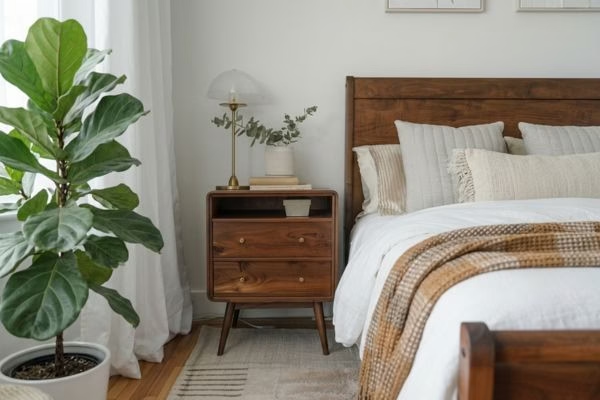
Walnut is a visually rich material — that’s the point of choosing it. The risk is that, placed incorrectly or in the wrong proportions, it can make a bedroom feel heavy and enclosed rather than warm and composed. These are the decisions that determine which outcome you get.
Finding the Right Height and Proportion Next to Your Mattress
The same sizing rule applies to walnut as to any bedside table: height should match the top of your mattress, within 5cm above or below. For standard beds, this means 55–65cm. For platform beds, 45–55cm. For walnut specifically, getting this right matters more than with lighter species — a walnut bedside table that’s too tall creates a looming, enclosed feeling in the corner of the bedroom. One at the right height sits naturally beside the bed as a companion rather than a presence.
💡 Measure mattress top height before browsing. Width: 30–40cm for most bedrooms; go narrower only if space genuinely requires it — a very slim walnut bedside table can look proportionally slight against a large bed.
Matching Walnut Bedside Table with Mid-Century, Japandi, or Contemporary Interiors
Walnut is the defining material of mid-century design. Tapered legs, clean horizontal planes, and minimal ornamentation — all characteristic of this style — allow walnut to be the hero material without competing with anything else. Works perfectly with warm whites, terracotta, and mustard textile accents.
Walnut’s warmth and depth are perfectly suited to Japandi — its natural drama complements the aesthetic of deliberate restraint. Keep surrounding elements quiet: linen bedding, matte walls in warm greige or sage, simple ceramic lamp bases. The walnut does the speaking; everything else listens.
In a predominantly neutral, white, or grey contemporary bedroom, a walnut piece becomes the singular warm element — which can be highly effective. The key is using it as an intentional accent rather than competing it with other warm materials at the same scale.
Storage Reality: Do You Need Two Drawers, or Just an Open Shelf?
The honest answer is that most people need less bedside storage than they think they do — but more than a purely minimalist design provides. A walnut bedside table with a single drawer of 70–90mm internal height covers the genuine overnight essentials: charger, reading glasses, earplugs, a small notebook. A lower open shelf handles a current book and a candle. That combination — top surface, one drawer, one shelf — serves the vast majority of users’ actual nightly needs.
Two full drawers, on the other hand, tend to accumulate the objects that don’t quite have a home elsewhere — which is a storage problem, not a walnut bedside table problem. If your bedside accumulation goes beyond overnight essentials, a narrow bedside table with a proper door may be more honest than a second drawer that becomes a miscellaneous drawer within six months.
6. Sustainability in 2026: Why EU Buyers Demand Transparency
Walnut is not a fast-growing timber. American black walnut takes 50–100 years to reach furniture-grade maturity; European walnut is similarly slow. This means responsible sourcing is not a secondary concern — it’s central to whether the purchase makes ethical sense at all.
FSC Certification: Ensuring Your Walnut Is Responsibly Sourced
FSC (Forest Stewardship Council) certification for walnut confirms the timber comes from forests managed to environmental, social, and economic standards verified by independent auditors. For American black walnut — the most common species used in European furniture — FSC-certified sources from sustainably managed US and Canadian forests are available and should be the baseline expectation for any premium purchase.
Verify FSC certification by asking for the supplier’s FSC licence code (format: FSC-CXXXXXX) and checking it at info.fsc.org. A label alone without a verifiable code is not certification — it’s decoration. This check takes thirty seconds and distinguishes genuine certification from marketing language.
EUDR Compliance: The Strict New European Law You Need to Know About
- The EU Deforestation Regulation (EUDR) requires all wood products entering the EU market to be traceable to their specific forest plot of origin — verified by GPS coordinates confirming the land was not deforested after December 2020
- This applies to walnut imported from the US, Canada, and all non-EU origins — the requirement is for plot-level geolocation data, significantly more specific than FSC forest-level certification
- Suppliers who are EUDR-compliant will have due diligence documentation available. This is not a supplementary request; it is a legal requirement for market access in the EU
- For B2B buyers specifically: EUDR non-compliance by your supplier creates legal liability at the importer level. Verifying compliance upfront is supply chain due diligence, not optional
Ask any supplier of walnut furniture directly: “Can you provide EUDR due diligence documentation for this product’s timber supply chain?” A compliant furniture factory will answer promptly and specifically. A vague or deflective response is a meaningful red flag.
FAQ — Walnut Bedside Table: Your Questions Answered
Click each question to expand the answer.
📋 Final Thoughts: The Best Walnut Bedside Table Is the One That Endures
Walnut isn’t a wood you buy cheaply and feel good about. It’s a material with genuine physical and aesthetic presence, and a piece made from it deserves the craft and attention that allow those qualities to be expressed fully. When that happens — when the grain is properly matched, the finish allows the wood to breathe, the joinery is solid, and the dimensions are right for the room — a walnut bedside table becomes furniture that you stop noticing as furniture and start experiencing simply as warmth.
That’s the outcome worth investing toward. Not a label, not a trend, not a price point — but a piece that genuinely improves the room it lives in, every day, for the next twenty years.
- ✓ Material transparency: solid walnut or quality veneer (1.5mm+ with solid edge lipping)? Ask — a specific, confident answer is a quality signal in itself
- ✓ Finish quality: oil or lacquer? Water-based? VOC level? The finish determines daily tactile experience and long-term repairability more than any other single factor
- ✓ Sourcing documentation: FSC licence code (verifiable) + EUDR due diligence documentation — both are standard requirements for responsible EU market suppliers, not premium extras
For B2B buyers and sourcing teams looking for an OEM manufacturer or furniture factory that understands walnut — from EUDR-compliant sourcing and calibrated kiln drying to low-VOC European oil finishing and precision grain matching — the right partner treats this material with the respect it deserves, not as a commodity to be processed and shipped. That distinction shows in the finished product and in every year of use that follows.