
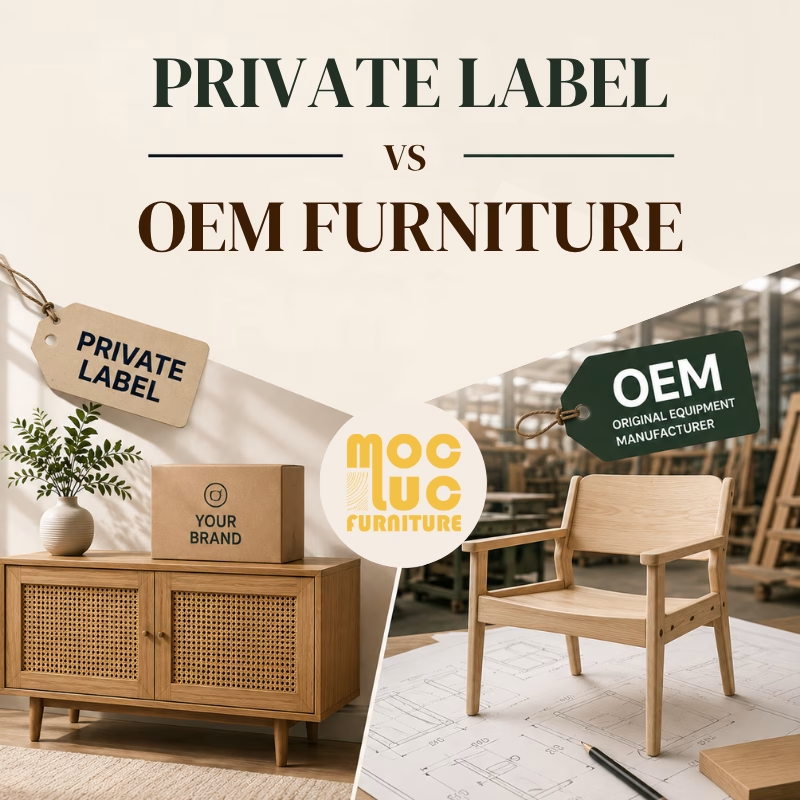
White Label, Private Label vs OEM furniture suppliers use these terms differently, leaving buyers unsure about who controls the design, whether the product is exclusive, how much customization is possible, and who handles development. The useful question is not which sourcing label sounds better, but who controls the product specification, how much development is required, and what exclusivity terms have actually been agreed. This guide breaks down the practical differences so you can choose a sourcing approach that fits your brand and product strategy.
- White Label — existing supplier product, limited customization, sold under buyer’s branding
- Private Label — manufactured by a third party, sold under buyer’s brand; customization and exclusivity depend on the programme
- OEM — manufacturer produces to buyer-controlled drawings, design intent, or technical specifications
- Overlap is common: a product can be both OEM-manufactured and sold under the buyer’s private label
*Do not choose by terminology alone — compare the actual development scope, customization, exclusivity, and contractual terms.

The sourcing model you choose shapes how much control you have over design, specification, and exclusivity.
1. White Label, Private Label and OEM Furniture Explained
White Label Furniture
White label furniture starts from an existing supplier product — a catalogue item or established design. The buyer typically adds their logo and packaging, with limited changes to the product itself. When the base product is already production-ready, a white-label programme can often reach market faster and require less product-development work. However, the same base product may be available to multiple buyers.
White label works best when speed matters more than owning a highly differentiated product.
Private Label Furniture
Private label furniture is manufactured by a third party but sold under the buyer’s brand. The programme can start from an existing supplier platform, a modified design, or a buyer-defined variation. Customization may include dimensions, materials, finish, upholstery, and packaging. Exclusivity is not automatic — it can be negotiated by product, territory, sales channel, or customer segment.
Private label offers more differentiation than a basic white-label programme without necessarily requiring a completely new design.
OEM Furniture Manufacturing
In OEM furniture manufacturing, the buyer typically provides or controls the design intent, drawings, dimensions, materials, and finish requirements. The manufacturer reviews manufacturability, develops samples, and produces to the approved specification. For a deeper look at how OEM compares to ODM, see our guide to OEM vs ODM furniture manufacturing.
OEM gives the buyer greater control over the product specification, but it does not automatically determine who owns every piece of intellectual property. Clear IP terms in supplier agreements should define ownership, permitted use, confidentiality, and any agreed exclusivity.

2. Private Label vs OEM Furniture: Key Differences
| Criteria | White Label | Private Label | OEM |
|---|---|---|---|
| Starting point | Existing supplier product | Existing platform or buyer variation | Buyer-controlled spec |
| Development effort | Usually lower | Low to moderate | Usually higher |
| Customization | Limited | Moderate to substantial | Deeper spec control |
| Exclusivity | Usually limited | Depends on contract | Depends on contract |
| IP ownership | Underlying rights depend on supplier/product IP | Depends on agreement | Depends on agreement |
| Time to market | Often faster | Depends on scope | Often longer |
| Supplier switching | Often easier | Depends on customization | Can be more complex |
| Best fit | Fast launch, demand testing | Buyer-branded differentiation | Buyer-controlled development |
Key takeaway: The biggest difference is not the logo on the product. It is how much control the buyer needs over design, specification, exclusivity, and the development process. MOQ structure also varies across all three models.
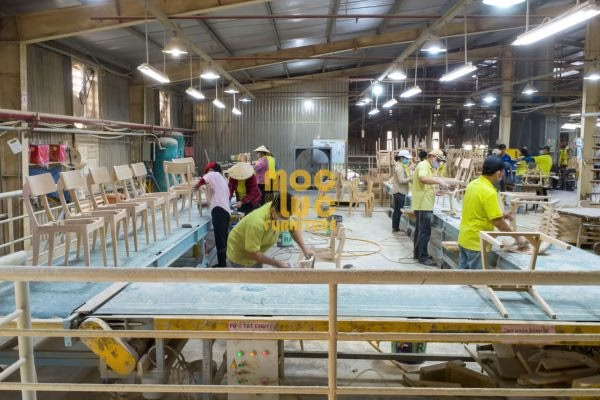
Whether white label, private label, or OEM — the sourcing model shapes your development workload and product control.
3. Which Furniture Sourcing Model Should Your Brand Choose?
Consider White Label When…
- Speed to market is the priority
- You want to test demand before investing in development
- An existing supplier product already fits your target customer
- Product differentiation is not your main competitive advantage
Consider Private Label Furniture When…
- You want products sold under your own brand
- You need more differentiation than a generic catalogue item
- Customization of finish, material, dimensions, or packaging matters
- You do not yet need a ground-up custom product
Consider OEM Furniture Manufacturing When…
- You already have or want to control your own product specification
- Exact dimensions, construction, materials, or finish are critical
- Your team can support sampling, revisions, and technical approval
- Product differentiation and contractual control outweigh launch speed
At Moc Luc, the development scope is defined by what the buyer already controls. We distinguish whether the buyer has a completed design or only a reference, which dimensions and materials must stay fixed, what the factory may adjust, whether exclusivity is required, and how many variants the programme involves. Changing a finish on an existing product is a very different project from changing dimensions, construction, or structural details — which may require additional technical review and sampling.

The right sourcing model depends on your product strategy — not on which label sounds better.
FAQ — Private Label vs OEM Furniture
Click each question to read the full answer.
Conclusion: Choose the Model That Matches Your Product Strategy
When choosing between private-label and OEM sourcing, the label matters less than the agreement behind it.
Before choosing a sourcing model, define who controls the design, how much customization you need, what exclusivity matters to your brand, and how IP will be handled. Those questions tell you more than the words “private label” or “OEM” alone. Learn more about finding the right wood furniture manufacturer in Vietnam.
Discuss Your Furniture Development Requirements
Moc Luc — Flexible OEM/ODM Partner for Solid Wood Furniture Brands
Whether you are adapting an existing furniture concept or developing a product from your own specification, Moc Luc can review your project requirements and help define the appropriate development scope.