

Choosing the wrong furniture manufacturer for a hospitality project can trigger a chain of problems: failed samples, inconsistent finishes across rooms, compliance-documentation gaps, production delays and costly rework. Yet many procurement teams still evaluate suppliers primarily by factory size, quotation price or the number of certificates listed on a company profile.
The lowest quotation does not necessarily mean the lowest total project risk. A large factory or a long certificate list does not automatically prove that a supplier fits your specific product, specification or destination market. An effective hospitality furniture manufacturer audit examines documentation, materials, production process and commercial terms against your actual project requirements.
This guide explains how to vet a furniture manufacturer for a hospitality project through a four-phase framework — from supplier pre-qualification to contractual controls — so procurement teams can connect every critical requirement to verifiable evidence before mass production begins.
Quick Answer: How Do You Vet a Hospitality Furniture Manufacturer?
- Pre-qualify the supplier — check relevant experience, project-specific requirements and available production capacity.
- Audit the factory — evaluate materials, engineering controls, finishing process and quality-control documentation.
- Approve a representative sample or mockup — confirm dimensions, function, finish, hardware and packaging suitability.
- Define commercial controls — agree on inspection criteria, delivery milestones, warranty scope and change-management terms.
Do not ask only whether a supplier “has BIFMA,” “has FSC,” or “uses AQL.” Ask which requirement applies to your product and what evidence proves it has been met.
In This Guide

Knowing how to vet a furniture manufacturer starts with verifying the supplier before you invest time in an on-site factory audit.
Phase 1 — How to Pre-Vet a Furniture Manufacturer Before a Factory Visit
Verify Relevant Hospitality Experience
Request supplier references for projects similar in product type, order complexity, programme scale, destination market and technical requirements. A reference from a well-known hotel name does not guarantee the supplier can handle your specific product category — relevant project similarity matters more than brand prestige.
Where feasible, cross-check with a previous buyer or project partner about communication quality, sample-approval process, schedule performance, production consistency and problem resolution.
Verify Product-Specific Compliance Requirements
Before reviewing any test report, determine which requirements actually apply to your product type, intended use and destination market. For a broader explanation of how export requirements vary by product and destination market, see our guide to what export-grade furniture means.
For example, ANSI/BIFMA X5.4 may apply to certain public-area seating; EN 16139:2025 covers non-domestic seating in European markets; UK upholstered-seating projects may reference BS 7176 and associated BS 5852 testing depending on the specification.
Buyer question: Which requirements apply to this exact product, and what report proves that the ordered construction meets them?
Check Real Production Capacity
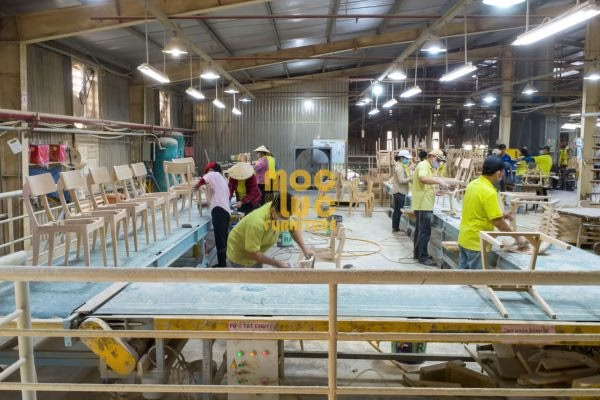
Do not evaluate capacity by factory floor area, total employees or containers-per-month claims alone. Ask the supplier to explain current production load, available production window for your product category, critical subcontracted processes, raw-material lead times, bottleneck operations and contingency planning.
The question is how your order fits into the actual production schedule — not how large the factory is. Understanding how MOQ and production planning work helps buyers set realistic expectations during this phase.
Phase 2 — How to Vet a Furniture Manufacturer During a Factory Audit
Materials, Moisture Control and Traceability

Solid wood: Inspect the kiln-drying process, documented moisture specification, measurement records and storage conditions before production. The appropriate moisture level depends on wood species, component, production process and expected service environment — there is no single universal percentage that applies to every hospitality product.
Composite wood: For applicable US-bound products, check TSCA Title VI evidence for regulated MDF, particleboard and hardwood plywood components. TSCA Title VI relates to composite-wood formaldehyde emissions, not coating certification.
FSC: If the project requires FSC-certified materials, verify Chain of Custody evidence matching the required claim scope. FSC addresses traceability — it does not prove overall furniture durability. FSC certification alone does not establish EUDR compliance. For EU-bound wood products within EUDR scope, assess whether the supplier can support the required origin, traceability and due-diligence information.
Hardware: Confirm the exact approved brand/model or agreed performance specification. Corrosion resistance is relevant primarily when the project environment requires it.
Engineering, Drawing Control and Production Repeatability
CNC machinery alone does not indicate a high-quality factory. What matters is whether the supplier maintains controlled production drawings with revision numbers, approved dimensions and tolerances, a change-approval process, appropriate jigs and fixtures, and demonstrated sample-to-production consistency.
The construction method — whether mortise-and-tenon, double dowel, corner blocks or another technique — should match the approved design, meet required performance and be reproducible consistently across batches. The important question is not which joinery the factory prefers, but whether the approved construction can be repeated at production scale.
Finishing and Quality-Control Process
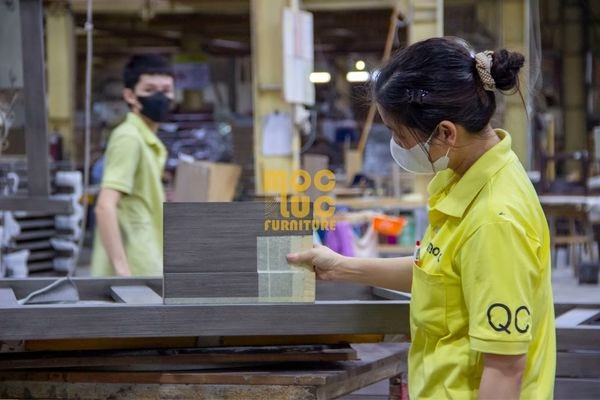
Evaluate the finishing process against approved colour/finish references, surface preparation, application method, curing, gloss/colour consistency and defect handling. If the project specification calls for low-emitting furniture, identify the exact VOC or indoor-air requirement and request matching evidence. UL GREENGUARD is one example certification programme where specified — but do not assume that water-based lacquer or hardwax oil automatically means low VOC.
For quality control, look for documented controls covering incoming materials, in-process inspection, dimensions, function, finish, final inspection, rework handling and production release. If sampling or AQL will be used, agree in advance on the sampling plan, defect classifications, acceptance criteria and final-release process — do not apply a universal AQL number.
Factory Perspective — Moc Luc: A factory audit is most useful when the buyer brings a clear product specification or approved reference. This allows the production team to demonstrate how drawings, materials, finish references, inspection points and approved samples are controlled against the actual project — rather than presenting generic factory capabilities.
Phase 3 — Validate the Product Before Mass Production

Approve a Representative Mockup or Sample
Hospitality projects should include a representative sample or mockup when the project scope warrants it. Evaluate dimensions, proportions, comfort, hardware operation, doors/drawers, upholstery, finish quality, installation interfaces and coordination with the overall room design.
All review comments must be documented, revisions formally approved and the final approved sample clearly identified as the production reference. Without a clearly approved production reference, it becomes much harder to resolve differences in dimensions, finish, construction or visible quality during mass production.
Validate Packaging for the Actual Distribution Channel
Packaging design should be based on product weight, shape, finish sensitivity, fragile areas, assembled or knock-down condition, handling method and the actual shipping route. Depending on the shipment method, an appropriate ISTA procedure or ASTM D4169-based validation plan may be used.
Packaging should be validated against how the furniture will actually be handled and transported — not against a generic “export packaging” formula.
Phase 4 — Define Commercial and Contractual Controls
Inspection and acceptance: Define the inspection stage, acceptance criteria, release authority and defect-resolution procedure before production starts.
Delivery commitments: Document milestones, shipment windows, buyer-approval dependencies and the impact of material changes or change orders on the programme.
Warranty: Review scope, exclusions, commercial-use conditions, claim procedure, repair/replacement responsibility and spare-part support. Do not use a fixed number of years as a universal benchmark — warranty terms should reflect the product, application and agreed commercial conditions.
Payment terms: Align payment with agreed production milestones, inspection gates, shipment and commercial risk allocation.
Delay and change management: Clarify delivery responsibility, change-order procedure, extensions of time, buyer-caused delays, notification requirements and agreed remedies.
Red flag: Unclear acceptance, delivery or change-control responsibilities in any supplier agreement.
Furniture Manufacturer Vetting Checklist for Hospitality Projects
| Audit Area | What to Verify | Evidence to Request | Red Flags |
|---|---|---|---|
| Supplier Qualification | Relevant experience and available capacity | Project references, production plan, company information | No verifiable experience; unsupported capacity claims |
| Product Requirements | Applicable testing/compliance for exact product | Product-specific reports, project specification | Generic certificates unrelated to ordered model |
| Materials & Traceability | Species, substrates, source and required claims | Material records, FSC evidence where specified, TSCA/EUDR information where applicable | Material/source claims cannot be documented |
| Engineering & Production | Drawing control and repeatability | Controlled drawings, revision records, approved sample | No controlled specification or change process |
| Quality Control | Inspection and release process | QC records, defect criteria, final inspection evidence | No documented inspection process |
| Mockup / Sample | Fit, function, finish and approval | Signed approval or punch list | Mass production begins without an agreed approval reference |
| Packaging | Suitability for actual shipment route | Packaging specification and relevant validation | Packaging not validated for the ordered product or shipment route |
| Commercial Controls | Delivery, acceptance, warranty and changes | PO, contract, quality agreement | Ambiguous responsibilities or acceptance terms |
GEO Takeaway: A strong hospitality supplier audit connects every important project requirement to evidence — a drawing, test report, material record, approved sample, QC record or contractual commitment.
Frequently Asked Questions
Conclusion: Vet the Evidence, Not Just the Factory

Knowing how to vet a furniture manufacturer means looking beyond factory size and certificates. A reliable supplier review follows four phases: relevant experience, production controls, product validation and clear commercial responsibilities.
The strongest hospitality furniture suppliers are not simply the factories with the most machines or certificates. They are the ones that can show how your approved specification is translated into materials, production controls, samples, inspections and delivery commitments throughout the project.
For hospitality buyers sourcing custom solid-wood furniture, Moc Luc can review project drawings, material requirements, finishes and expected production scope before sampling begins. This helps identify which requirements need technical review, factory evidence or project-specific approval before mass production.
Discuss Your Furniture Development Requirements
Moc Luc — Custom Solid Wood Furniture Manufacturing for Hospitality and B2B Projects