
Updated 18 September 2026 to reflect the current EUDR application timeline and amended Annex I product scope.

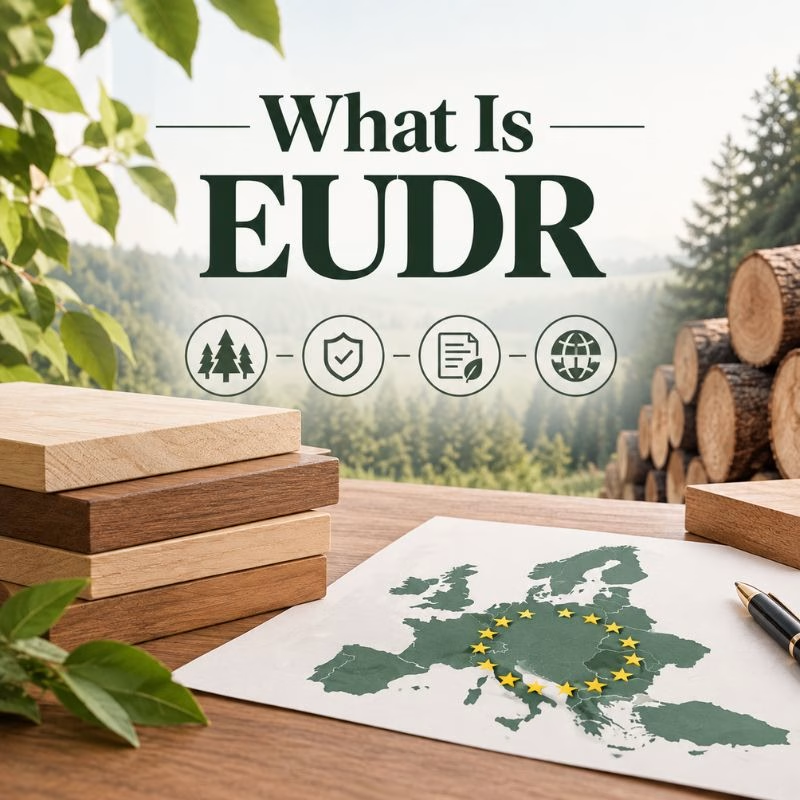
What is EUDR, and why does it matter to furniture importers? The EU Deforestation Regulation (EUDR) changes how in-scope wood and furniture products are documented before they enter the EU market. Large and medium operators — together with micro and small operators previously covered by the former EUTR — are subject to the Regulation from 30 December 2026, while most other micro and small operators follow from 30 June 2027.
For furniture importers, EUDR means that a supplier invoice or FSC certificate alone is not enough to demonstrate compliance. Buyers need to understand whether a product falls within Annex I, collect the required upstream timber information and know which company in the supply chain carries the relevant due-diligence responsibility. This guide explains what EUDR requires, which furniture products are affected and how overseas furniture manufacturers can support buyer readiness.
Quick Answer: What Does EUDR Mean for Furniture Importers?
EUDR (Regulation (EU) 2023/1115) requires that relevant products placed on the EU market are deforestation-free, produced in accordance with the legislation of the country of production, and covered by the applicable due-diligence/declaration requirements.
For furniture importers, EUDR turns timber origin from a supplier-level claim into a documented supply-chain requirement: the responsible operator must know where the relevant wood came from, assess the associated risk and complete the required declaration before placing an in-scope product on the EU market.
What Is EUDR and When Does It Apply to Furniture Importers?

EUDR is the EU Deforestation Regulation governing specified commodities and relevant products linked to deforestation and forest degradation. For furniture importers, the key issue now is when the Regulation starts to apply to their business.
30 December 2026: large and medium operators, plus micro/small operators previously covered by EUTR. 30 June 2027: most other micro and small operators. Because sourcing, sampling, production and ocean freight can span several months, timber traceability needs to be built into the purchasing process before the purchase order — not assembled just before customs clearance.
Buyer takeaway: Treat EUDR data readiness as a pre-order sourcing requirement, not a document request made at the last mile.
Which Furniture Products Are Covered by EUDR?
Check the CN Code — Not Simply Whether the Product Contains Wood
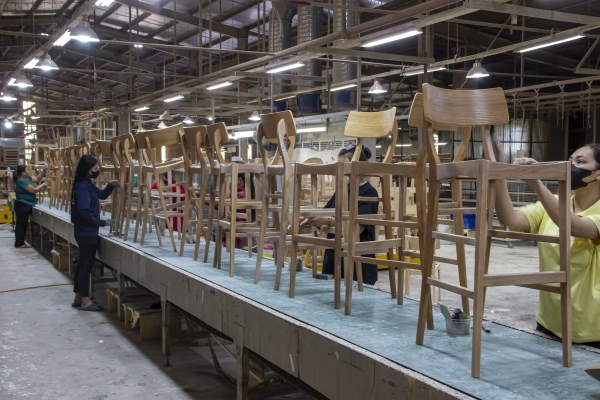
EUDR scope is determined by the relevant products listed in Annex I — not by whether a product simply contains a wooden component. Annex I was updated by Commission Delegated Regulation (EU) 2026/2102. Furniture groups relevant to buyers include, among others: selected ex 9401 wooden seating categories, ex 9403 30 wooden office furniture, ex 9403 40 wooden kitchen furniture, ex 9403 50 wooden bedroom furniture, ex 9403 60 other wooden furniture and ex 9403 91 wooden furniture parts. Current Annex wording excludes used and second-hand products from these entries.
If in-scope furniture uses plywood, MDF, particleboard or other wood-based components, the importer needs sufficient upstream information to support due diligence for the relevant product. Importers should verify the exact CN classification rather than assume every product containing wood is automatically covered.
Who Is Responsible for EUDR Compliance?
In a typical third-country furniture import, the business acting as the operator that first places the relevant product on the EU market generally carries the primary due-diligence and DDS responsibility. Downstream operators and traders still retain applicable information and traceability duties depending on their role and size.
The overseas supplier is not typically the actor that submits the DDS in a standard import transaction — but the OEM factory is the source of critical upstream data: timber species, origin, production-plot information, supply-chain records and supporting legality documentation. The EU operator carries the legal filing obligation, but compliance can fail upstream if the overseas factory cannot supply reliable timber-origin data.
What Information Does a Furniture Importer Need for EUDR?
1. Identify the timber and supply chain: product description, quantity, the common name and full scientific name of the wood species used, country of production, suppliers and relevant supply-chain actors.
2. Trace the wood to the production plot: Geolocation normally requires at least one latitude/longitude point for plots up to 4 ha and a polygon describing the perimeter for plots over 4 ha. The importer needs traceability beyond country or region level.
3. Assess deforestation and legality risk: verify whether evidence supports deforestation-free status (cut-off date: 31 December 2020) and compliance with relevant laws of the country of production.
4. Mitigate risk where necessary: if risk cannot be assessed as negligible, request additional information, conduct further verification or use independent audit/survey where appropriate.
5. Submit the DDS: the operator submits the due-diligence statement through the EUDR Information System on the EU TRACES platform before placing the relevant product on the market. For imported goods, the compliance workflow must be completed before release for free circulation.
For buyers sourcing from Vietnam: Vietnam is currently classified as a low-risk country under the EUDR benchmarking system. This can allow simplified due diligence under Article 13 where the relevant conditions are met, but it does not remove the operator’s Article 9 information requirements or the applicable DDS obligation.
Does FSC or PEFC Certification Make Furniture EUDR Compliant?
No. FSC or PEFC certification does not automatically make a furniture product EUDR-compliant. Certification can support chain-of-custody information, timber sourcing records and risk assessment evidence — but it does not replace product-scope verification, required geolocation, legality/deforestation assessment or the DDS obligation of the relevant operator.
Buyers should assess the actual data readiness of their supplier rather than relying on a single question: “Do you have FSC?” More useful supplier questions include:
- Can you identify the timber species and upstream source used for this order?
- Can you provide the required plot-level traceability data?
- Can your records connect the purchased wood to the finished furniture shipment?
What Are the Risks of EUDR Non-Compliance?
Article 25 requires Member States to provide effective, proportionate and dissuasive penalties. For legal persons, the maximum fine framework must allow a ceiling of at least 4% of total annual Union-wide turnover — though not every violation triggers the maximum. Other potential sanctions include confiscation of relevant products or revenues, temporary exclusion from public procurement and, for serious or repeated infringements, temporary restrictions on placing relevant products on the market.
Beyond statutory penalties, importers face commercial risks: customs delays, re-documentation costs, shipment disruption and loss of buyer confidence.
EUDR Readiness Checklist for Furniture Importers
| Before Ordering | What to Verify |
|---|---|
| Product scope | Exact CN code and Annex I status |
| Wood material | Species and wood-based components |
| Origin | Country + required production-plot data |
| Supplier evidence | Traceability and relevant legality records |
| Risk review | Deforestation, legality and supply-chain risk |
| Data gaps | Additional verification/mitigation where needed |
| DDS readiness | Required data available before market placement |
| Contract | Define who provides data, by when, and how corrections are handled |
Buyer takeaway: A supplier’s willingness to provide documents is not enough. The importer needs a traceable data chain linking the relevant timber source to the furniture being placed on the EU market.
How an OEM Furniture Manufacturer Can Support EUDR Readiness

An overseas manufacturer does not replace the EU operator’s legal responsibility. However, a capable OEM factory supports readiness by providing timber species information, maintaining origin records, supporting plot-level traceability, connecting timber data to production batches and responding to buyer document requests.
For buyers sourcing export-grade furniture, Moc Luc can work with buyers to identify the material, supplier and traceability information required for each project and coordinate available documentation through the sourcing process. This does not constitute EUDR certification or a guarantee of EUDR compliance — the filing obligation remains with the responsible EU operator.
Conclusion: Build EUDR Into Furniture Sourcing Before Shipment
First verify whether the product is in scope. Identify the responsible operator. Collect traceability data upstream. Resolve gaps before shipment and market placement. An OEM manufacturer adds the most value when it maintains structured timber records and can coordinate with the buyer’s due-diligence workflow from purchase order through production. For furniture importers, EUDR readiness starts with the purchase order and the timber supply chain — not at the EU border.
For sourcing teams preparing for EUDR application dates, Moc Luc can review timber-source documentation, material records and traceability support at order level — helping buyers identify data gaps before production begins.
Discuss Your Furniture Development Requirements
Moc Luc — Flexible OEM/ODM Partner for Solid Wood Furniture Brands